Joan Didion, 2021 (Foreword by Hilton Als)
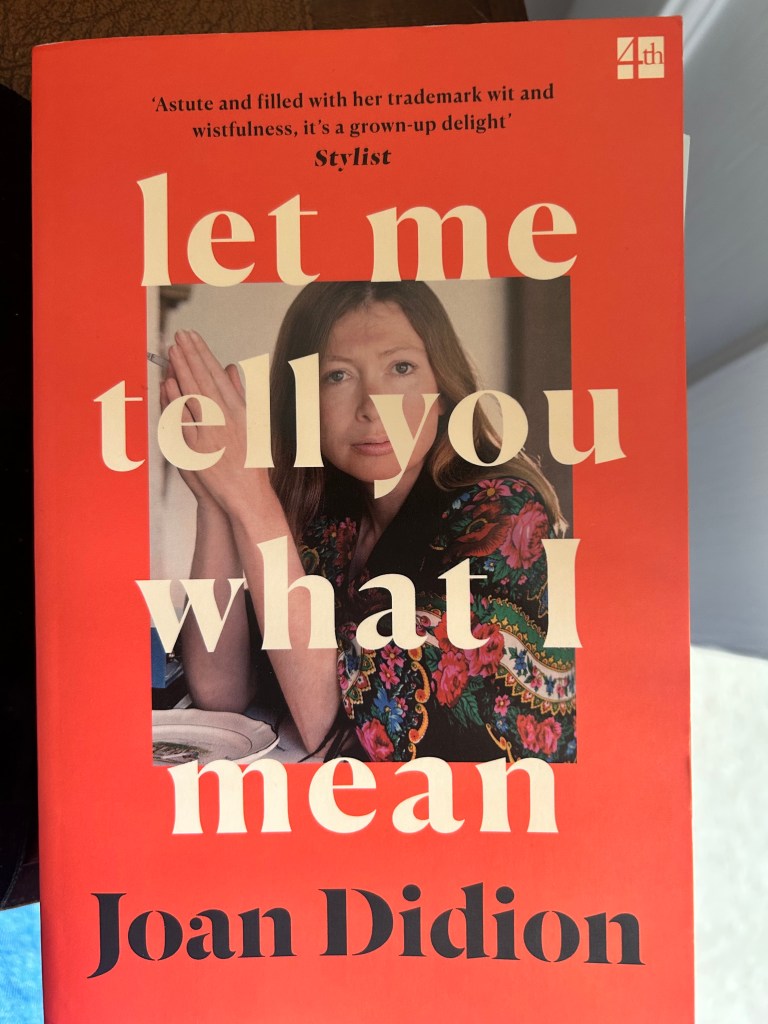
I didn’t know Joan Didion’s work until I got to college, which is probably quite late for a writer and student of literature. Didion is widely-praised for her reporting, essays and fiction. I was taught Slouching Towards Bethlehem, and went on to read most of her nonfiction and her novel, Play It as It Lays, which is (in part) about a mother being manipulated by her soon-to-be ex-husband and forced to seek an illegal abortion. When I attended Norman Mailer’s public memorial service, she offered a brief remembrance, and I was absolutely astonished by how small she was. She had lorded over my mind as a giant, and here was this fragile person and voice stretching up to a microphone on a massive, empty stage in Carnegie Hall.
In spite of that image, she remained a giant. It was not until recently that I began to seriously write essays, but it is her work that has fascinated me for decades.
This collection of essays is mainly the 60s and 70s, many of which any Didion reader would have come across before. Reading these together brought to mind the documentaries of Louis Theroux, in that Didion approaches her subject with a curious and balanced attitude, all while glancing toward an obvious truth. Theroux tends to do the same — he speaks to his subjects with genuine interest, but often there is an invisible judgment, or at least confusion, about, say, gun rights or throuples. The reporting is unbiased, but we can tell what the storyteller truly thinks.
For example, in Last Words, her essay on Hemingway, she discusses the matter of his posthumous publications, which Hemingway expressly did not want published. She begins with the opening passage to A Farewell to Arms (one of my favorite novels), and notes the incredible cadence that Hemingway establishes with “four deceptively simple sentences…Twenty-four of the words are ‘the,’ fifteen are ‘and.’ There are four commas.” She then shares the facts of Hemingway’s wishes and the actions of his wife and son, who edited his last, unfinished 850 page manuscript, True at First Light, to half as many pages.” While she does drive home the point, what she cleverly implies with this anecdote is that no other person could possibly have placed those ‘ands’ and commas the way Hemingway would have wanted them. She very easily convinced me to never read that final novel, if I am to honor his wishes, and to feel a little guilty for reading Hemingway’s letter to Norman Mailer when I was a student at Wilkes and helping Mike Lennon, Mailer’s biographer, to organize his correspondence.
…people whose work it is to make something out of nothing do not much like to talk about what they do or how they do it….The attempt to analyze one’s work, which is to say to know one’s subject, is seen as destructive.
Joan Didion, Some Women, 1989
I think the most compelling essay is Why I Write, in which she details her approach to working on Play It as It Lays. But first she explains how she came to writing as a vocation: “I write entirely to find out what I’m thinking, what I’m looking at, what I see and what it means. What I want and what I fear.” This is not an essay that intends to tell writers how to be writers, but it certainly conveys that message. It calls for a commitment to curiosity, a dedication to “arranging words on a piece of paper.” She makes it sound extremely basic while admitting that the self-interrogation inherent to writing is maybe the most important thing we can do for ourselves. But it is her acerbic style that proves her point.
It’s Didion, so it’s five stars.
 Monica Cardenas